

Christine Jean-Pierre
CSMS Magazine
In the United States, conversations about dual heritage often say more about society’s assumptions than about the individuals living them. Americans born to parents from different cultural backgrounds frequently navigate multiple identities at once—yet the public and the media tend to settle on just one. The result is a simplified narrative that flattens the full richness of a person’s roots.
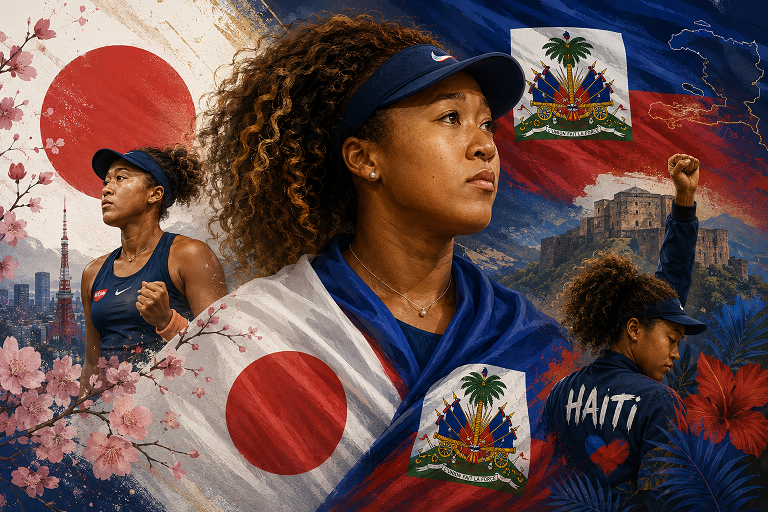
Tennis champion Naomi Osaka embodies this tension perhaps more visibly than most. Born in Japan to a Japanese mother and a Haitian father, and raised largely in the United States, she carries three cultural worlds within her. Yet Western media has historically emphasized her Japanese identity—especially when Japan celebrates her victories—while her Haitian heritage is too often treated as a mere footnote, rather than an equal and integral part of who she is.
This imbalance is hardly Osaka’s alone. Across American society, people of mixed heritage are frequently expected to fit into a single box. Which identity gets highlighted is often determined by appearance, nationality, marketability, or public convenience—not by the individual’s own sense of self. For a global figure like Osaka, this tendency toward simplification can unintentionally erase a vital thread of her family story.
What makes Osaka’s case so compelling is that she has repeatedly chosen to remind the world of her Haitian roots—through her clothing, her public statements, her social media, and her solidarity with Haiti in times of crisis. In doing so, she makes clear that being Japanese does not diminish being Haitian. Both exist fully, simultaneously, and deserve equal recognition.
There is profound meaning in these gestures. They reveal Osaka’s understanding of visibility. Haiti is too often discussed internationally only through the lens of instability, disaster, or hardship. Positive representations of Haitian excellence on the global stage remain rare. By embracing her heritage so openly, Osaka offers a counternarrative—one of resilience, family, culture, and pride.
Some might ask why these reminders are necessary. The answer lies in representation. When the public repeatedly names only one side of a person’s identity, the other gradually fades from collective consciousness. For those of mixed ancestry, this can feel like a quiet form of erasure—even when unintended.
This experience extends far beyond Osaka. Millions of Americans with dual or multicultural backgrounds know the weight of questions like, “What are you really?” or “Which side do you identify with more?” Such questions presume identity is a choice between competing worlds, rather than a coexistence of both. But cultural identity is rarely either-or. It is layered, evolving, and deeply personal.
Media organizations bear responsibility here too. Journalists have an opportunity—and an obligation—to present public figures in their full complexity, rather than reinforcing reductive tropes. Naming Osaka as both Japanese and Haitian is not merely a matter of accuracy; it is an acknowledgment of the multicultural reality that increasingly defines modern life.
Ultimately, Naomi Osaka should not have to keep reminding the world that she is Haitian. Her heritage is not an accessory she pulls out through fashion or words on special occasions. It is part of her every single day—just as much as her Japanese identity. Celebrating one side should never require diminishing the other. In an increasingly diverse society, the deeper lesson may be this: we do not need to split people into singular identities to understand them. They can belong fully to every part of their story—and that complexity deserves to be seen, respected, and celebrated.
Also see: One Nation, One Dream: A Nation’s Pride on Soccer’s Biggest Stage