

Aline Morrison
CSMS Magazine
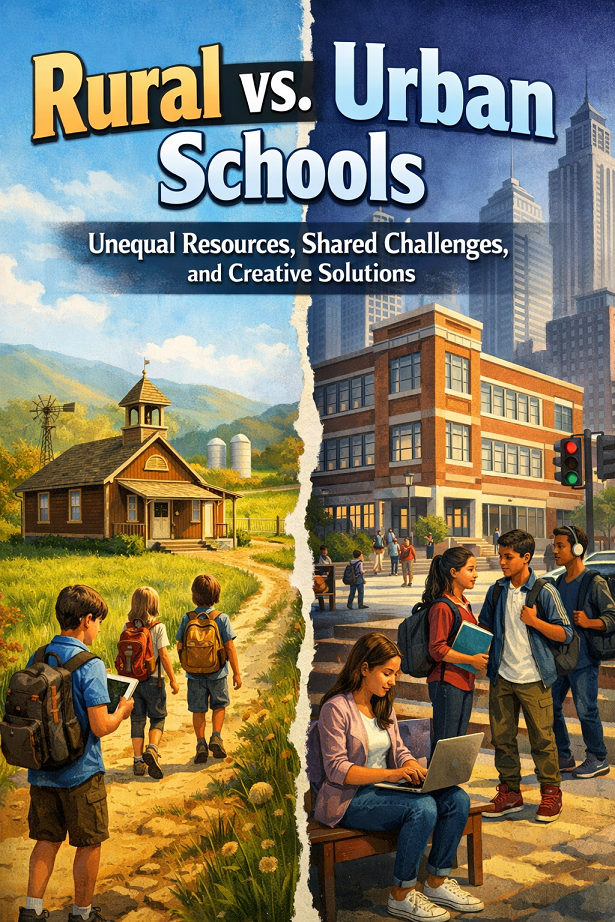
The divide between rural and urban schools in America is often framed as a tale of stark inequality. Urban districts frequently serve large, densely populated communities with significant cultural diversity and high student mobility. Rural schools, by contrast, are typically smaller, more geographically isolated, and deeply rooted in tight-knit communities. While their circumstances differ, both face persistent challenges tied to funding, staffing, infrastructure, and student opportunity.
One of the most visible differences lies in resources. Urban schools may have access to larger tax bases, philanthropic partnerships, and nearby universities or cultural institutions. Yet they also grapple with overcrowded classrooms, aging facilities, and concentrated poverty. Rural schools, on the other hand, often operate with limited budgets due to smaller local tax revenues. Geographic isolation can mean fewer Advanced Placement courses, limited extracurricular options, and reduced access to specialized services such as speech therapy or advanced STEM labs.
Teacher recruitment and retention present shared but distinct challenges. Urban districts may struggle with high turnover rates, burnout, and safety concerns. Rural districts frequently face shortages because attracting educators to remote areas can be difficult, especially when salaries are lower and professional networks are limited. In both contexts, students ultimately feel the impact when experienced educators are hard to retain.
Despite these disparities, rural and urban schools share common hurdles: addressing learning gaps widened by the pandemic, integrating technology effectively, supporting student mental health, and preparing graduates for a rapidly evolving workforce. Whether in a crowded city corridor or along a quiet country highway, educators are tasked with meeting diverse academic and social-emotional needs.
Encouragingly, creative solutions are emerging in both settings. Rural districts are leveraging virtual learning partnerships to expand course offerings, allowing students to take specialized classes online that would otherwise be unavailable. Community-based mentorship programs connect students with local business owners, farmers, and tradespeople, turning geographic isolation into hands-on learning opportunities.
Urban schools are forming collaborations with nonprofits and tech companies to provide after-school enrichment, coding programs, and college readiness initiatives. Some are redesigning large schools into smaller learning academies to foster stronger relationships and personalized instruction.
Ultimately, the rural-urban divide is less about competition and more about equity. While resources may differ, the mission remains the same: to provide every student with a high-quality education and a pathway to opportunity. By sharing innovative strategies and advocating for fair funding models, policymakers and educators can bridge gaps and ensure that location does not determine destiny.
Also see: Financial Literacy for the Next Generation: Why Teaching Money Management Early Matters