

Christine Jean-Pierre
CSMS Magazine
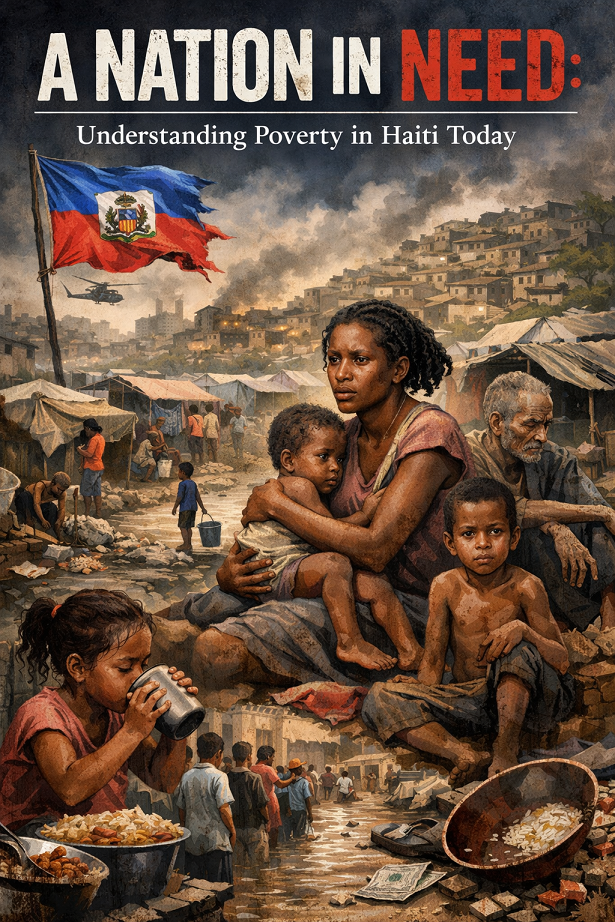
Haiti remains the poorest country in the Western Hemisphere, and in recent years poverty has deepened due to economic decline, political instability, and widespread violence. For millions of Haitians, daily life is marked by hunger, unemployment, and limited access to basic services. The country’s ongoing crises have reversed many development gains and left much of the population struggling to survive.
Recent estimates show that more than 66 percent of Haitians live on less than $3.65 per day, highlighting the scale of economic hardship across the nation. In extreme terms, about 29 percent of the population lives on less than $2.15 per day, the international threshold for extreme poverty. Overall, more than six million people are estimated to live below the poverty line, reflecting a deep and persistent economic crisis.
Food insecurity is one of the most visible consequences of poverty in Haiti. Humanitarian organizations report that approximately 5.7 million people—nearly half the population—face acute food insecurity, meaning they struggle to obtain enough food for their families. Among them, hundreds of thousands are experiencing emergency levels of hunger, while some communities are approaching famine-like conditions. Children are particularly vulnerable, with more than one million facing severe food insecurity.
Several factors contribute to Haiti’s worsening poverty. The country’s economy has contracted for several consecutive years, leaving fewer jobs and shrinking incomes. At the same time, high inflation—especially rising food prices—has made basic goods increasingly unaffordable. Political instability and gang violence have disrupted businesses, agriculture, and transportation, further weakening the economy and limiting opportunities for employment.
Poverty in Haiti is also tied to limited access to essential services. Many households lack reliable electricity, clean water, sanitation, and healthcare. Rural communities are particularly disadvantaged, with poverty rates far higher than in urban areas. Weak infrastructure and a struggling health system mean that millions of Haitians face daily challenges in meeting basic needs.
Despite these hardships, humanitarian organizations and local communities continue to work toward solutions through aid programs, education initiatives, and economic development efforts. However, lasting progress will require improved political stability, economic investment, and sustained international support to reduce poverty and rebuild Haiti’s social and economic foundations.
Also see: Haiti at an Impasse: The Impossible Road to Transition