

Ardain Isma
CSMS Magazine
Editor’s Note
Long-term relationships are rarely undone by a single act. More often, they are tested by silence, unspoken fears, and the stories we tell ourselves when communication falters. When Silence Became the Third Presence explores the quiet distance that can arise when suspicion replaces dialogue—and how naming fear, rather than fleeing it, can become an act of courage.
This story is offered not as instruction, but as reflection, for readers navigating doubt, withdrawal, or the fragile space between trust and uncertainty. It invites us to consider how easily we retreat when we are afraid—and how much may still be possible when we choose to speak.
________________________________________________________________________
When Silence Became the Third Presence
For fifteen years, Jean and Mireille had lived side by side in the same apartment, long enough to forget the sound of each other’s footsteps. Their life was not unhappy—only settled, like furniture that had not been moved in years. On Saturdays, Jean used to walk with her to the grocery store two blocks away. They would argue gently over tomatoes, laugh about prices, complain about the radio playing the same songs from another decade.
Then one day, he stopped asking.
At first, Mireille thought it was fatigue. Jean came home quieter, ate quickly, disappeared behind his phone. He no longer suggested walks. When she asked if something was wrong, he replied, “Nothing,” with the finality of a door being closed.
What Jean did not say—what he could not yet say—was that a thought had lodged itself in his mind like a splinter. He had noticed the way Mireille mentioned a colleague’s name once too often. The brightness in her voice. The pause before she answered a question. Nothing scandalous. Nothing provable. But enough to awaken suspicion, that most corrosive of emotions.
From that moment on, Jean began to watch instead of speak. He read meanings into silences. He counted smiles. Each neutral gesture became evidence in a private trial where Mireille had no defense because she did not know she was being judged.
He told himself he was protecting his dignity. In truth, he was retreating.
The grocery store became symbolic. If he went with her, he feared he might explode—with accusations he could not substantiate, with questions he did not want answered. So he stayed home. Silence, he believed, was safer than truth.
Mireille felt the distance long before she understood it. She noticed how absence entered the house—not loudly, but politely, like an uninvited guest who never leaves. She missed the walks, the small rituals. She wondered if she had done something wrong, replayed conversations in her mind, searched herself for a crime she could not name.
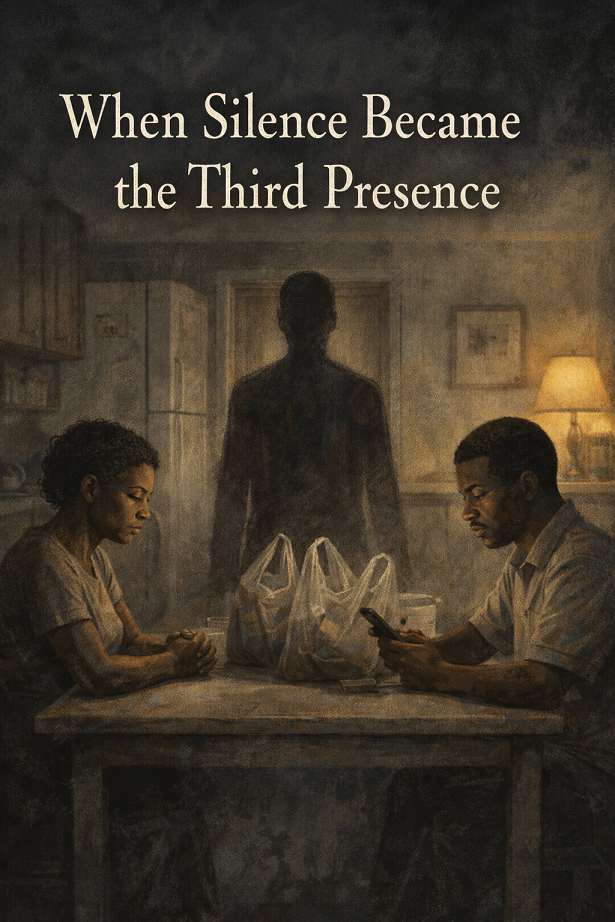
One evening, after weeks of this quiet estrangement, Mireille placed two bags of groceries on the counter and sat down without putting them away.
“Jean,” she said softly, “I feel like you left, but your body stayed.”
The sentence struck him harder than any accusation could have. He wanted to deny it. Instead, something in him cracked—not into anger, but into fatigue.
“I don’t know how to ask you this,” he finally said, staring at the floor. “And I don’t know if I want the answer.”
Mireille waited. Silence, for once, was not used as a weapon.
“I’m afraid,” he continued, “that there is someone else in your thoughts.”
She did not react with outrage. She did not laugh. She sighed—the sigh of someone who has been waiting for the real question.
“There is no one else in my life,” she said. “But if you are asking whether I’ve felt invisible sometimes… then yes. I have.”
The words hung between them, fragile and dangerous.
They talked that night—not to resolve everything, but to name it. The loneliness. The routines. The way years can dull attentiveness without dulling affection. Jean realized that what frightened him most was not another man, but the possibility that his marriage required effort again.
They did not emerge healed. They emerged honest.
The following Saturday, Jean picked up his jacket and hesitated by the door.
“Do you still need milk?” he asked.
Mireille smiled—not because everything was fixed, but because something had resumed.
Some marriages end in betrayal. Others end quietly, by people who stop walking together long before they separate. Jean learned that suspicion, left unspoken, can do more damage than truth spoken imperfectly.
Divorce may sometimes be necessary. But silence, when used to avoid fear, almost always is.
 Note: Ardain Isma is a university professor, novelist, essayist, and scholar. He serves as Chief Editor of CSMS Magazine and leads Village Care Publishing, an indie press dedicated to multicultural and social-justice-oriented literature. His works include Midnight at Noon, Bittersweet Memories of Last Spring, Last Spring was Bittersweet and The Cry of a Lone Bird – his latest novel which explores resilience, love, and the enduring quest for human dignity.
Also see: Where the River Meets the Sea


A heartwarming story! As always Author Ardain Isma weaves magic with his words!