

Marc-Antoine Dusset
Special to CSMS Magazine
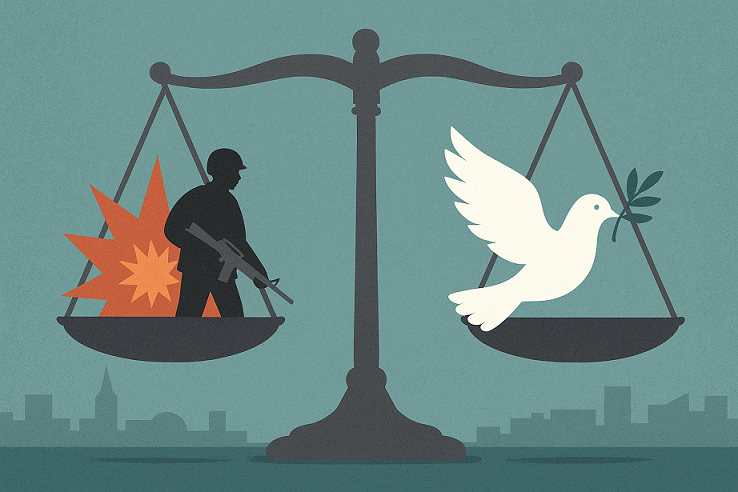
In today’s interconnected world, war and peace are no longer abstract concepts relegated to history books—they are daily realities that shape international affairs, human rights, and the future of global governance. From Eastern Europe to the Middle East and Africa, conflicts continue to erupt and persist, raising urgent questions about the effectiveness of international law and the resilience of diplomacy. The international community, once hopeful that the end of the Cold War would usher in a more stable era, now finds itself grappling with a patchwork of conflicts that reveal the fragility of peace and the limits of global cooperation.
One of the most striking aspects of modern warfare is how it tests the institutions created to prevent and resolve conflict. The United Nations, conceived as a mechanism to maintain peace and security, has often found itself paralyzed by the competing interests of powerful member states. In cases such as the war in Ukraine or the civil strife in Syria, the veto power of permanent Security Council members has hindered collective action, highlighting a structural flaw in the global order. This inability to act decisively in moments of crisis erodes trust in international law, which was designed to safeguard sovereignty, protect civilians, and prevent atrocities.
At the same time, the proliferation of non-state actors—from insurgent groups to private military contractors—complicates the application of international law. Unlike traditional state armies, these actors often operate outside legal frameworks, blurring the lines of accountability. Civilian populations frequently bear the brunt of this reality, as humanitarian law struggles to keep pace with new forms of conflict. The use of cyberwarfare and drones adds yet another layer of complexity, creating battlefields without borders and testing whether existing treaties can adapt to modern technologies of war.
Diplomacy, long considered the first line of defense against conflict, is also under strain. Negotiations are increasingly complicated by fractured alliances, shifting power dynamics, and domestic political pressures. In some cases, peace talks drag on for years without tangible results, as seen in efforts to broker solutions in Yemen or South Sudan. Meanwhile, rival powers use proxy wars as a means of advancing their own strategic interests, making resolution even more elusive. The very concept of diplomacy as a neutral tool is being challenged, with growing mistrust between nations undermining the credibility of negotiations.
Yet, despite these obstacles, moments of progress remind us of the enduring potential of diplomacy. Ceasefire agreements, prisoner exchanges, and humanitarian corridors, though often temporary, demonstrate that dialogue can still alleviate suffering and build incremental trust. Regional organizations like the African Union and the European Union have stepped into mediating roles, showing that collective leadership beyond the UN can sometimes achieve breakthroughs. Civil society groups, too, are playing a growing role in peacebuilding, advocating for inclusive processes that bring women, youth, and marginalized communities to the negotiating table.
The persistence of war also underscores the urgent need to reimagine international law for the 21st century. Legal scholars and policymakers argue for reforms that would strengthen enforcement mechanisms, close accountability gaps, and adapt frameworks to new realities like cyber conflict. Without such evolution, the gap between the ideals of law and the realities of war will only widen. Diplomacy, too, must innovate—incorporating technology, citizen engagement, and new formats of dialogue that go beyond traditional backroom negotiations.
Ultimately, the current landscape of conflict reveals both the shortcomings and the possibilities of the international system. While wars continue to expose the weaknesses of global governance, they also highlight the importance of recommitting to law, diplomacy, and collective action. The challenges are immense, but so too is the human capacity to adapt and persevere in the pursuit of peace. The question is not whether international law and diplomacy can survive the tests of ongoing conflicts, but whether global leaders have the will to transform them into stronger, more effective tools for a world that desperately needs them.
Note: Marc-Antoine Dusset is poet and editorialist. He wrote this piece, especially for CSMS Magazine. Also, see: Peace in the Middle East: An elusive dream?