

Ardain Isma
CSMS Magazine
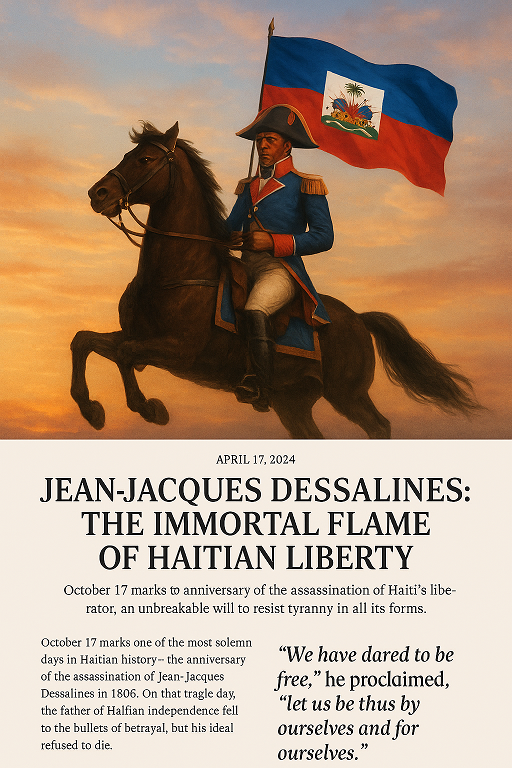
October 17 marks one of the most solemn days in Haitian history—the anniversary of the assassination of Jean-Jacques Dessalines in 1806. On that tragic day, the father of Haitian independence fell to the bullets of betrayal, but his ideals refused to die. In every generation since, his name resounds as a symbol of unyielding courage, uncompromising freedom, and an unbreakable will to resist tyranny in all its forms.
Born enslaved on the Cormier plantation near Grande-Rivière-du-Nord, Dessalines rose from the deepest abyss of colonial oppression to become the architect of the world’s first Black republic. His journey defied every law of empire. A man who once bore the scars of the whip, he transformed those scars into emblems of resistance. As commander of the revolutionary army, he not only outmaneuvered the mighty forces of France, Spain, and Britain but also redefined what it meant to be human in an age that denied the humanity of Africans.
When he declared Haiti’s independence on January 1, 1804, Dessalines did more than found a nation—he shattered the ideological backbone of slavery. His proclamation, read in Gonaïves, was both a birth certificate and a thunderous manifesto of emancipation. “We have dared to be free,” he proclaimed, “let us be thus by ourselves and for ourselves.” For the first time in modern history, the enslaved had not only broken their chains but had built a state upon the ashes of bondage. Haiti became a beacon to the oppressed everywhere, a living refutation of white supremacy, and a nightmare to every empire built on human subjugation.
Dessalines’ rule was brief, often misunderstood, and deliberately vilified by colonial propagandists who feared his example. Yet even his fiercest critics could not deny the magnitude of his vision. He sought to reconstruct a nation ravaged by centuries of exploitation—to restore dignity to those who had been treated as beasts of burden. His constitution of 1805 outlawed slavery forever, declared all citizens equal regardless of color, and boldly stated that every Haitian would henceforth be known as “Black,” a revolutionary act of solidarity that erased the colonial divisions between free people of color and the formerly enslaved.
He envisioned a society rooted in independence of mind and soil, where foreign powers could never again dictate the destiny of the Caribbean’s most fertile land. But the wounds of the revolution were deep, and rival ambitions among the elite sowed the seeds of tragedy. On that fateful October morning, Dessalines—Haiti’s liberator, its first emperor, and its fiercest defender—was ambushed and murdered at Pont-Rouge, north of Port-au-Prince. His body was desecrated, but his spirit became immortal.
Today, as Haiti faces renewed trials—political instability, economic despair, and the lingering shadow of foreign interference—the lessons of Dessalines echo louder than ever. He reminds us that true independence is not a date on a calendar but a continuous struggle for dignity and self-determination. His legacy calls upon each generation to resist the forces that seek to fragment and diminish the Haitian soul.
To remember Dessalines is not merely to mourn; it is to recommit—to his dream of a just and sovereign Haiti, to his belief that freedom must be defended with vigilance, and to his conviction that the worth of a people is measured by their courage to rise again after every fall.
Two centuries have passed since the guns of Pont-Rouge were silenced, yet their echo still stirs the conscience of all who yearn for justice. Dessalines lives wherever the oppressed dare to speak, wherever a lone voice insists on equality, and wherever freedom is cherished above comfort. His blood consecrated the soil of Haiti, but his vision belongs to humanity.
Jean-Jacques Dessalines, immortal spirit of liberty—your flame still burns.
 Note: Ardain Isma is the Chief-Editor of CSMS Magazine. He is the author of several books, including Midnight at Noon, Bittersweet Memories of Last Spring, Last Spring was Bittersweet and The Cry of a Lone Bird You can order these books by clicking on the links above.