

Christine Jean-Pierre
CSMS Magazine
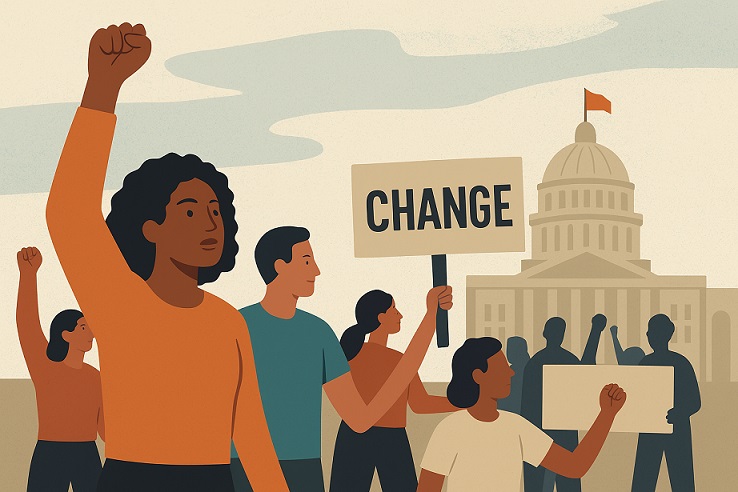
In recent years, the story of political change has often begun not in the halls of government, but in the streets, schools, and neighborhoods where ordinary people organize to make their voices heard. Grassroots movements, driven by the energy of local communities, are increasingly shaping the national agenda. From environmental justice campaigns to racial equality protests and voting rights initiatives, these local movements are proving that lasting change does not always come from the top down—it often rises from the bottom up.
The strength of grassroots power lies in its accessibility. Unlike political parties or elite institutions, grassroots movements draw on the collective energy of ordinary people who share a common cause. Local leaders, often unpaid and without formal political experience, step forward to rally neighbors and build coalitions. They organize town halls, marches, and social media campaigns that bring attention to issues overlooked by mainstream politics. This process not only amplifies marginalized voices but also makes change feel personal and achievable for communities historically excluded from decision-making.
One of the most notable aspects of grassroots activism is its ability to connect local struggles with broader national or even global causes. For example, the fight for climate action has often begun with small, community-driven campaigns—such as local groups opposing polluting industries or advocating for clean energy. These localized battles, when replicated across regions, gain momentum and capture national attention. Similarly, the civil rights movement of the 1960s was built on countless local acts of resistance, from sit-ins at lunch counters to grassroots voter registration drives, which collectively transformed American society.
Today’s grassroots movements are also powered by digital tools. Social media platforms have given organizers the ability to bypass traditional gatekeepers and communicate directly with the public. A single viral post can transform a local protest into a national headline overnight. Movements such as Black Lives Matter, #MeToo, and various climate justice campaigns all began with individuals raising awareness online before becoming global calls for justice. This democratization of communication allows movements to grow faster, coordinate more effectively, and pressure institutions in ways that were not possible just a generation ago.
Yet grassroots activism is not without its challenges. Organizers often face limited resources, political resistance, and burnout. Unlike well-funded political campaigns, grassroots groups frequently rely on small donations and volunteer labor. Governments and corporations may also attempt to co-opt or suppress movements that threaten the status quo. Still, history shows that when grassroots movements remain persistent, their impact can outlast these obstacles. The very nature of grassroots power—its connection to the lived experiences of communities—gives it a resilience that larger institutions often lack.
The national political landscape is increasingly shaped by these local voices. Politicians are paying closer attention to grassroots movements, knowing they can mobilize voters and shift public opinion. Issues once considered fringe—such as marriage equality, climate justice, and police accountability—have entered mainstream political discourse largely because of grassroots persistence. In many cases, local victories pave the way for sweeping national reforms, proving that small steps in small towns can ripple outward into seismic political change.
Ultimately, grassroots power is a reminder that democracy is not a spectator sport. Real change is not limited to elections or legislative chambers but is built in neighborhoods, communities, and everyday conversations. Local movements give people the tools to challenge injustice, reimagine society, and demand accountability from those in power. By starting small, grassroots activists create the conditions for national transformation. As history has shown—and as today’s movements continue to prove—when ordinary people unite around a common cause, they have the power to change the direction of an entire nation.
Also see: War and Peace – Ongoing Conflicts Testing International Law and Diplomacy